
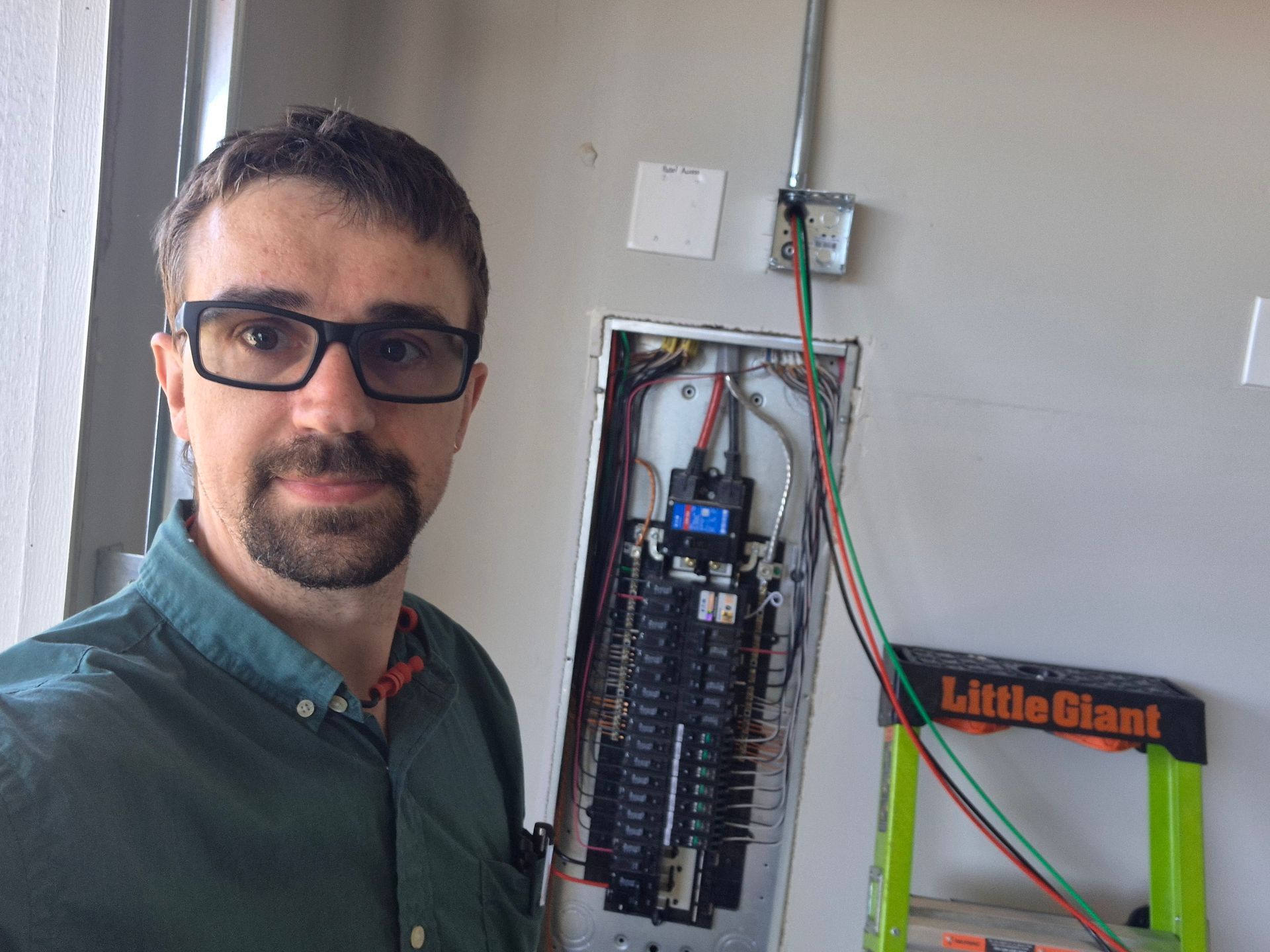
The Story Behind TH3 Electric
It makes sense to wonder about the people behind a business, especially when that business is as small and personal as mine.
At the time of writing this, TH3 Electric is still a very small operation. My wife handles much of the administrative work and organization, while I work directly with our customers and perform the installations. In the truest sense, we are a family-run, mom-and-pop business.
Because TH3 Electric has such a modest appearance, some people naturally wonder about the level of experience behind the company. I think that is a fair question.
This is the story of how I became an electrician and eventually started TH3 Electric.
2012–2014: Learning to Work With My Hands
After graduating from high school in 2010, I spent a few years working the typical starter jobs, including fast food and restaurant work. I rarely stayed in those positions for long because I felt there was little opportunity to grow or develop meaningful skills.
That began to change in 2012, when a new store opened and I was asked to help clean out what remained from the previous business.
The new store was called Digger’s Depot. It purchased the contents of abandoned storage units, cleared them out, and sold anything that still had value. Businesses like this became increasingly popular during the rise of television shows such as Storage Wars.
I was immediately fascinated by the operation—not necessarily because I believed in the business model, but because of the successful and experienced people behind it. I was also drawn to the constant variety of tools, equipment, furniture, machinery, and unusual items that came through the store.
My curiosity quickly caught the attention of the owner, Mr. Woody. Several younger workers helped during the store’s opening, but before long, I was the only one who remained.
I worked there for nearly three years and learned everything Mr. Woody was willing to teach me. The experience gave me basic mechanical skills, hands-on electrical experience, the ability to operate moving trucks and equipment, and the confidence to solve practical problems.
Eventually, I realized I had learned about as much as I could in that position. As I approached the end of my time in community college, I knew I needed to choose a long-term career. With a heavy heart, I left Digger’s Depot and began looking toward the future.
2014–2015: The Beginning of My Electrical Career
After leaving Digger’s Depot, I accepted work that was more closely aligned with what I was studying in school: mathematics education.
During that time, I worked at a care facility serving individuals with developmental disabilities. Although the position did not provide much additional mechanical experience, it helped lead me toward the career that would ultimately define my life.
At the time, I was not earning much money, and I was beginning to understand how difficult it could be to support a family on a teacher’s salary. This became even more important after I began dating Taylor Orr, who is now my wife.
I wanted a career that would allow me to build a stable life and provide for a family. One of my roommates was an electrical apprentice, and during a conversation about my future, he told me about traveling journeyman electricians who worked throughout the country and could earn more than $100,000 per year.
At first, I did not believe him.
Once I began researching the trade, however, I realized the opportunity was real. Electrical work offered a structured apprenticeship, valuable technical knowledge, strong earning potential, and skills that could never be taken away from me.
I began pursuing an electrical apprenticeship almost immediately.
2015–2020: The Apprenticeship
I had no idea how demanding my apprenticeship would be.
The electrical industry in Mississippi is very different from the industry here in Oregon. Mississippi does not have the same statewide electrical licensing system, and organized labor represented only a small portion of the electrical workforce. Work could be inconsistent, and during my first two years as an apprentice, I was laid off for a combined total of approximately 12 months.
Those years could easily fill an entire book.
Throughout my apprenticeship, I worked in power plants, animal exhibits, quarantine facilities, schools, casinos, airports, radio towers, and other industrial and commercial environments. I also gained experience performing bucket-truck work and working around specialized electrical systems.
Although I believe Mississippi lacks many of the electrical regulations and worker protections that we benefit from in Oregon, I also had the opportunity to learn from some remarkably skilled electricians.
The best journeymen I worked under seemed like wizards of the trade. In some ways, I still think of them that way.
Whenever I found someone willing to teach me, I paid attention. I asked questions, accepted difficult assignments, and absorbed as much knowledge as possible. Those mentors gave me a foundation that I could never have gained from a classroom alone.
2020: Becoming a Traveling Journeyman
When I finally received my journeyman certification, I never lost sight of the original goal that brought me into the trade.
On the day I was scheduled to receive my journeyman card, I immediately prepared to leave Mississippi and travel for work. My first position as a journeyman took me to Oklahoma, where I was placed with a crew of six apprentices.
It was an intense introduction to being responsible for others. Because I had come through such a demanding apprenticeship, I did not immediately recognize how unusually difficult the project leadership could be. Over time, however, I adapted, built a
relationship with my foreman, and learned how to manage a crew with very different personalities and experience levels.
Together, we completed some genuinely impressive work, including portions of the redundant power-distribution systems supporting a large data center.
From Oklahoma, I traveled to Reno, Nevada. While working there, I began pursuing electrical licenses throughout the West Coast, starting with Oregon.
I took the Oregon journeyman examination while I was still working in Reno and then traveled to Sacramento to work on a solar farm. While I was in Sacramento, I received the news that I had passed the Oregon licensing examination.
Soon afterward, I headed north.
2020–2025: Working as an Oregon Journeyman
When I arrived in Oregon, I had no intention of staying permanently.
That changed quickly.
The wages were approximately three times what I had earned before leaving Mississippi. Oregon also offered beautiful scenery, a diverse population, stronger electrical standards, and opportunities to work on projects I never imagined I would see.
Eventually, my wife and I agreed that Oregon was where we wanted to settle and raise our family.
Much of my Oregon career was spent working at Intel’s Ronler Acres campus. The facility is still one of the largest and most advanced industrial environments I have ever worked in. In many ways, it operates like a small city.
I had the opportunity to work on equipment and systems that I had previously only heard or read about. I never imagined that I would one day work at the same campus so closely connected to the history of Moore’s Law and the development of modern semiconductor technology.
As development began to slow and layoffs became increasingly likely, I returned to traveling for a period of time. I worked on a data center in Ohio and later on a solar project near Kennewick, Washington.
Eventually, I realized that I was spending more time away from my family than I was at home. I spent many exhausted hours considering my options. I thought about returning to Mississippi, relocating my family, finding another permanent industrial position, and nearly every possibility in between.
Those thoughts eventually led to the creation of TH3 Electric.

2025–Present: TH3 Electric
I never expected to start an electrical contracting business.
For a long time, I did not consider myself financially driven enough to become a successful business owner. As TH3 Electric has grown, however, I have begun to realize that this may actually be one of my greatest strengths.
My goal was never to build the largest electrical company in Oregon. I simply wanted to replace a normal 40-hour workweek, spend more time with my family, and provide honest electrical work to the people and businesses in my community.
Before TH3 Electric ever opened its doors, I had already earned my Oregon Supervising Electrician license. In Oregon, this represents a level of responsibility beyond the standard journeyman license and allows an electrician to supervise, design, and sign for electrical work at a higher level.
After starting TH3 Electric, I also began teaching advanced electrical classes for electricians preparing for the Supervising Electrician exam. Teaching at that level has sharpened my understanding of the electrical code, electrical theory, calculations, and the practical judgment required to apply them correctly in the field.
Because TH3 Electric has low overhead and extensive hands-on experience behind it, I can approach projects differently from many larger contractors. I can speak openly with customers, explain what I see, and recommend what I genuinely believe is appropriate for the situation.
My career has taken me through residential work, commercial facilities, industrial plants, data centers, semiconductor facilities, solar farms, schools, airports, casinos, and many other environments. That experience now supports every service call and installation completed by TH3 Electric.
So while TH3 Electric may be a small company, the experience behind it is not small.
Today, my wife and I operate TH3 Electric together. She keeps the administrative side organized, and I work directly with our customers from the initial conversation through the completion of the installation.
I may not have expected to build a business, but I am proud of what TH3 Electric is becoming.
My goal is simple: to make you glad you called.